
Research Article Summary
-
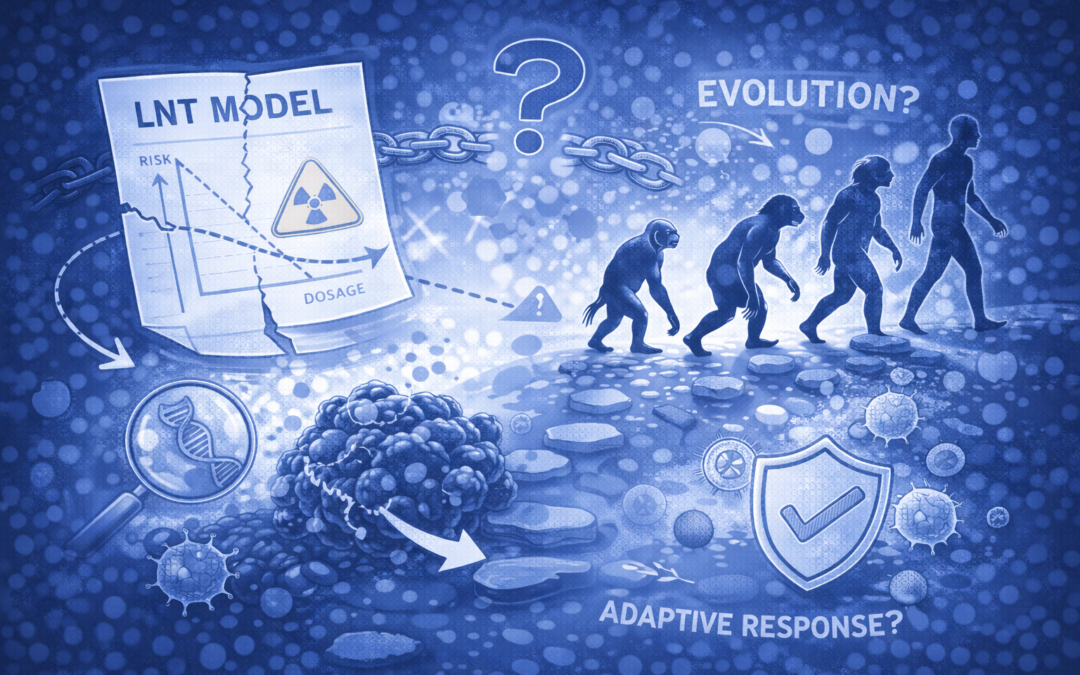
The article critically examines whether the linear no-threshold (LNT) dose-response model is inconsistent with principles of evolutionary biology, suggesting that LNT’s assumption of cumulative harm at arbitrarily low doses may contradict how organisms have evolved to respond to environmental stressors.
-
It discusses how biological systems possess adaptive mechanisms — including DNA repair, cellular signaling networks, and stress response pathways — that have evolved to manage and mitigate low-level damage, implying that responses at low doses are more complex than a strictly linear model predicts.
-
The piece analyzes evidence from toxicology, genetics, and evolutionary physiology showing that organisms often display non-linear and adaptive responses to low doses of radiation and chemicals, challenging the universality of LNT across biological contexts.
-
It evaluates theoretical arguments about the role of natural selection in shaping dose-response relationships, highlighting that evolutionary processes favor robustness and repair rather than passive accumulation of damage assumed by LNT.
-
The article concludes that framing LNT as an “anti-evolution” model underscores the need to integrate evolutionary and mechanistic biological insights into dose-response modeling, potentially leading to more biologically grounded approaches for risk assessment.