
Authors: Hugh Henry and James S. Welsh
Journal: Dose-Response (2026, 24(1))
DOI: 10.1177/15593258261420242
What it covers:
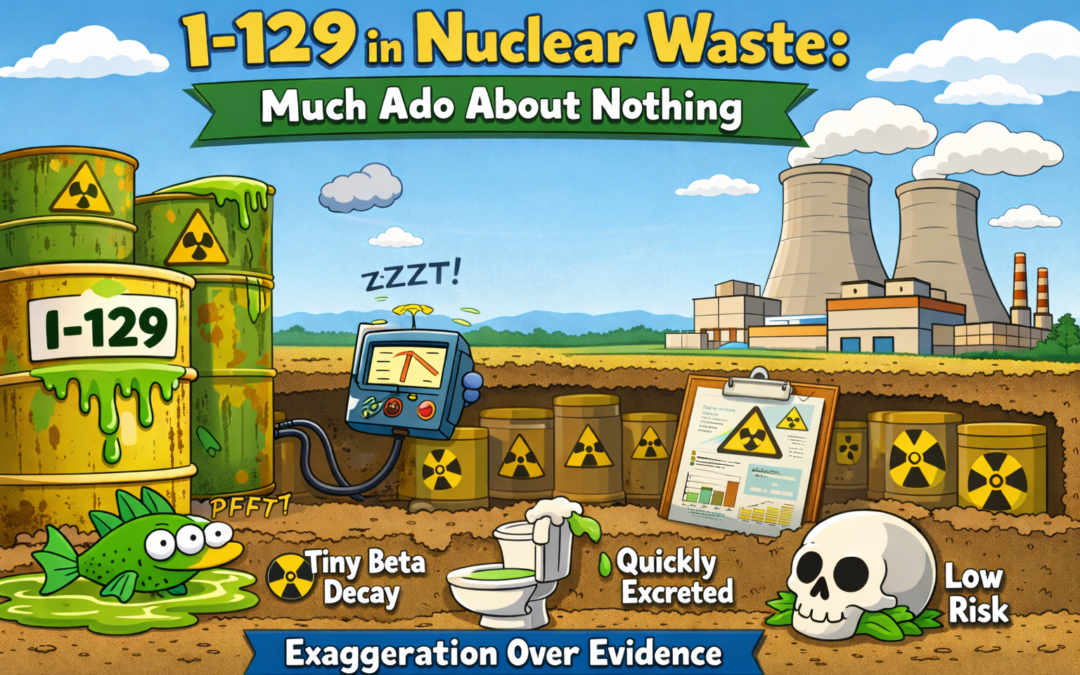
This short technical article reviews the radiological characteristics of iodine-129 (I-129) and argues that its hazard in nuclear waste has been overstated in some recent scientific discussions and media coverage.
Key points:
-
I-129 is a long-lived radioactive isotope with a half-life of about 15.7 million years, but its decay emits low-energy beta particles that contribute very little dose compared to many other radionuclides.
-
Although I-129 is produced in nuclear fission and can be released during fuel reprocessing or from low-level waste streams, its specific activity (decay rate per mass) is low and its radiation is low-LET (low biological damage potential).
-
Most ingested I-129 is rapidly excreted from the body, and even in conservative scenarios the potential for biological harm is very limited.
-
The authors conclude that much of the “hazard” attributed to I-129 in some recent literature amounts to exaggeration rather than evidence-based risk — hence the title’s reference to “much ado about nothing.”