
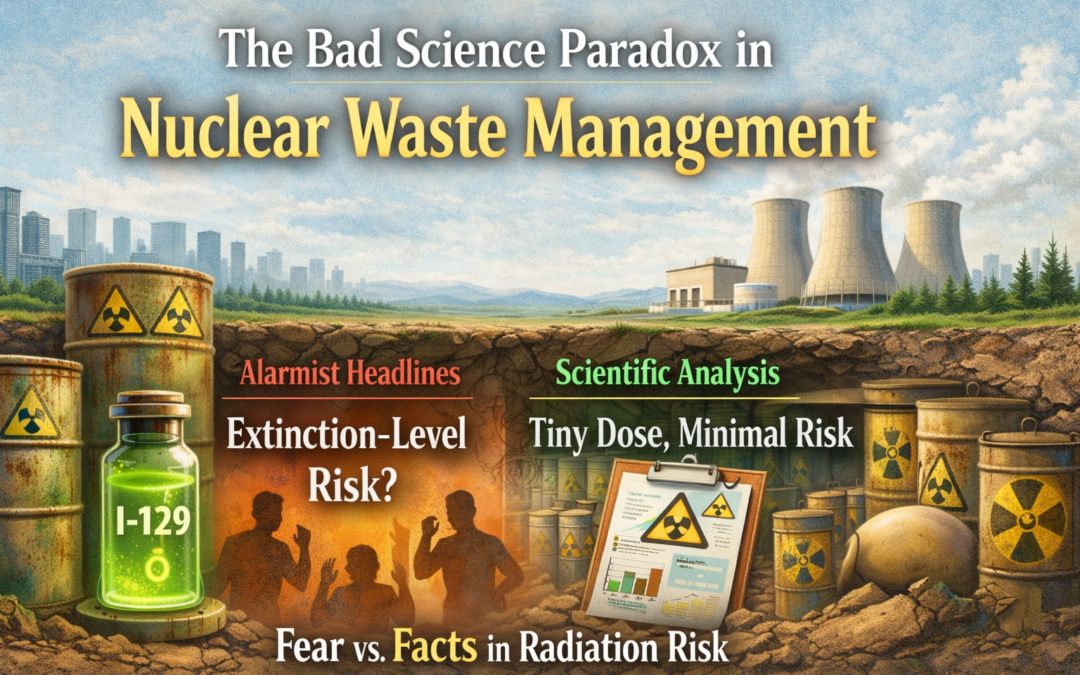
Main point: The piece criticizes a recent scientific paper on nuclear waste management for what the author sees as flawed reasoning and exaggerated claims about risk — calling it part of a “bad science paradox” in the field.
-
Critique of a Nature article: Hargraves refers to a Nature Sustainability study by MIT researchers on managing nuclear waste, especially focusing on the isotope iodine-129 (I-129).
-
I-129 characteristics:
• I-129 has an extremely long half-life (~16 million years).
• Hargraves acknowledges it is mobile in the environment, but argues the actual health risks are extremely low — claiming the biological half-life in humans (how quickly the body removes it) is short and decay events are rare. -
Counter-arguments cited: He points to a recent article in Dose-Response by radiation experts from Scientists for Accurate Radiation Information (SARI) that challenges the risk framing in the MIT paper, asserting that most I-129 would be excreted, and that the actual dose to human tissue from its decay is negligible.
-
Labeling fear-mongering: Hargraves argues that mainstream scientific reporting and journal publications can overstate hazards based on simplified “common knowledge” rather than detailed analysis — for example, suggesting AI summaries of the I-129 risk exaggerate the danger. He frames this as part of a broader pattern where fear-driven framing gets more attention than nuanced, numeric risk analyses.