The National Academy of Sciences Biological Effects of Atomic Radiation(BEAR) Genetics Panel recommended no second-generation genetic damage study of the offspring of the atomic bombings in Japan
by admin | Mar 5, 2026 | LNT Hypothesis, Technical Library |
Summary of Findings
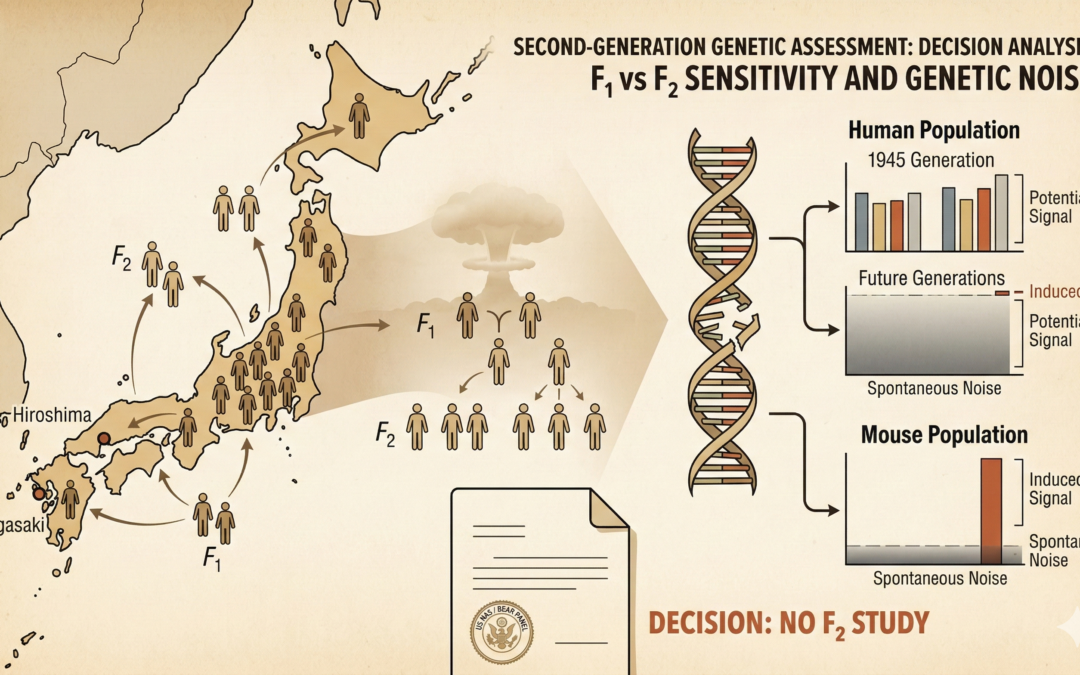
- Scientific Basis: The recommendation was primarily based on a 1962 memorandum by James V. Neel and William Schull, which argued that because the first-generation (F1) study of 75,000 children showed no significant genetic damage, a study of the F2 generation was highly unlikely to yield statistically significant results.
- Logistical Challenges: Neel noted that demonstrating genetic effects in the F2 would be hindered by administrative problems, specifically the expected dispersal of survivors’ children throughout Japan, making them difficult to track.
- Quantitative Assessment: Neel and Schull’s analysis estimated a potential F2 sample size of approximately 27,000 individuals, but they concluded that any induced genetic effect would naturally be weaker in the second generation than in the first.
- The “Noise” Factor: Researchers highlighted that detecting radiation-induced mutations in humans is exceptionally difficult due to high levels of genetic “noise”—preexisting and spontaneous mutations in the human population that obscure the signal of radiation damage.
- Consensus Among Experts: The decision was supported by a subcommittee of elite geneticists (Neel, Stern, and Sturtevant) and was not challenged by other members of the BEAR I Genetics Panel, including Nobel Laureates like Hermann J. Muller and Joshua Lederberg.
click here to see full article
