

Discussions about nuclear energy tend to revolve around fear, historical imagery, and worst-case scenarios. What gets far less attention is the reality that nuclear power has been quietly delivering large-scale benefits to society for decades. When judged by outcomes rather than perception, nuclear energy stands out as one of the most effective tools we have for addressing climate change, protecting public health, and sustaining modern economies. This isn’t a theoretical argument. It’s an operational one.

Environmental & Climate Benefits of Nuclear Power
A Low-Carbon Energy Source
Nuclear power plants generate electricity with near-zero carbon dioxide emissions during operation. That fact alone places nuclear energy in a small and important category: energy sources capable of producing large amounts of electricity without contributing to greenhouse gas accumulation. Unlike fossil fuels, nuclear reactors do not rely on combustion, no burning means no carbon exhaust. As countries struggle to reduce emissions without destabilizing their grids, this characteristic is not incidental, it is essential.
Clean Air and Public Health
Beyond climate concerns, nuclear power produces electricity without releasing air pollutants such as sulfur dioxide, nitrogen oxides, or fine particulate matter. These pollutants are strongly linked to asthma, heart disease, and premature death. This benefit is often overlooked. Clean energy discussions frequently focus on carbon while ignoring the very real health costs of air pollution. Nuclear power avoids both.
Minimal Land Use and Habitat Preservation
Nuclear facilities have a remarkably small physical footprint compared to other low-carbon energy sources. Producing the same amount of electricity with wind or solar requires orders of magnitude more land. That difference matters, land use affects ecosystems, agriculture, and biodiversity. Nuclear energy delivers large-scale power while leaving most of the surrounding environment untouched.

Economic & Social Benefits of Nuclear Power
Energy Security and National Independence
Energy systems are only as stable as their fuel supply. Nuclear fuel is compact, energy-dense, and easily stockpiled. This reduces dependence on continuous fuel imports and insulates countries from geopolitical shocks and price volatility. In practical terms, nuclear power strengthens national resilience.
High-Quality Jobs and Local Economic Stability
Nuclear plants support long-term, high-skill employment. Engineers, technicians, operators, and construction workers all play essential roles, and these jobs tend to be stable and well-compensated. For many communities, a nuclear facility becomes an economic anchor—providing tax revenue, infrastructure investment, and decades of steady employment.
Innovation Beyond Electricity
The influence of nuclear technology extends far beyond power generation. Advances in nuclear engineering underpin medical imaging, cancer therapy, industrial inspection, materials science, and even space exploration. Nuclear energy is not just a way to generate electricity. It is a foundation for broader technological progress.
A Strong Safety Record
When measured objectively—using fatalities per unit of energy produced—nuclear power ranks among the safest energy sources ever deployed. This remains true even when high-profile accidents are included in this analysis. The gap between public perception and statistical reality here is wide. The data themselves are not controversial. The fear surrounding them is.
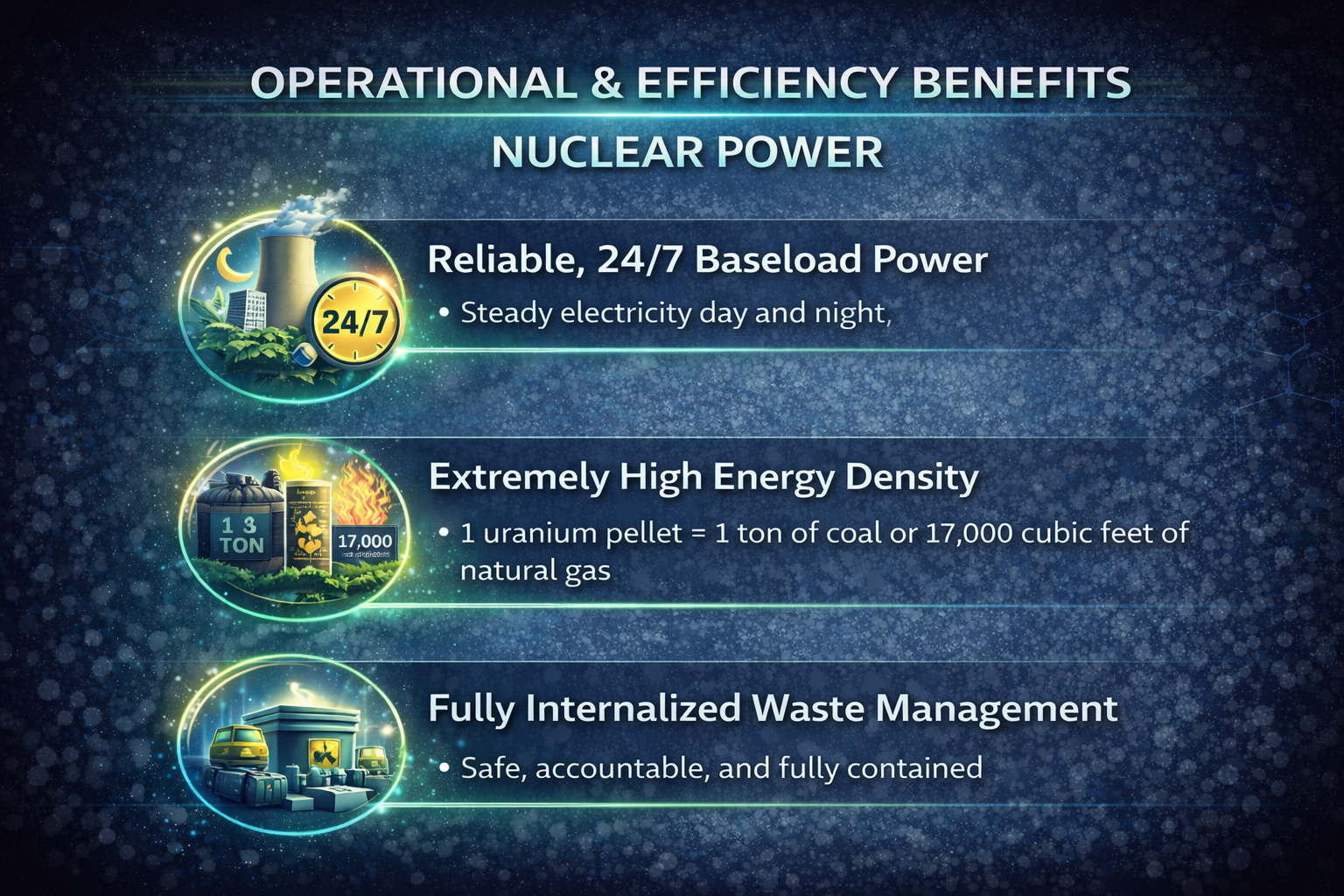
Operational & Efficiency Benefits of Nuclear Power
Reliable, 24/7 Baseload Power
Modern societies require electricity that is available at all times. Nuclear plants operate continuously, independent of weather or seasonal variation, making them uniquely suited to provide baseload power. Hospitals, transportation networks, data centers, and industrial systems all depend on this reliability.
Exceptional Energy Density
Nuclear fuel is extraordinarily efficient. A single uranium fuel pellet—roughly the size of a fingertip—can deliver as much energy as one ton of coal or about 17,000 cubic feet of natural gas. This efficiency reduces fuel handling, transportation, and material throughput. Less fuel. Less waste. More energy.
Fully Accounted Waste Management
Unlike fossil fuels, which disperse waste into the atmosphere, nuclear energy contains and manages its byproducts. Waste handling, storage, and eventual decommissioning are regulated, monitored, and financially internalized. Nothing is hidden. Nothing is externalized.
A Technology Limited More by Fear Than by Evidence
Despite these advantages, nuclear energy remains underutilized. The reason is not technical performance or safety record. It is perception—shaped largely by outdated risk models and decades of fear-based messaging. That fear carries consequences. It leads to higher emissions, poorer air quality, reduced energy security, and missed opportunities for innovation. These costs are real, even if they are rarely discussed in the same breath as nuclear risk.
Conclusion
Nuclear energy combines clean air, low carbon emissions, economic stability, technological innovation, and operational reliability in a way few other energy sources can match. At a time when global challenges demand practical energy solutions, nuclear power remains one of the most capable, yet most misunderstood, tools available. Reevaluating nuclear energy based on evidence rather than fear is not a matter of ideology. It is a matter of public health, environmental stewardship, and long-term prosperity.
Related Post
US Power Shortage: How Small Modular Nuclear Reactors Could Fill the Gap
Read the full article:
https://radiationeffects.org/us-power-shortage-how-small-modular-nuclear-reactors-could-fill-the-gap/
Nuclear Microreactors
Read the full article:
https://radiationeffects.org/nuclear-microreactors/